Saturn in Synastry
Saturn in Synastry: Relationship Astrology
When Saturn in one chart forms an aspect with another person’s personal planet or point, the energy interplays between the two people are distinct. Saturn is the planet of restriction, commitment, and reality. We usually find Saturn interaspects with personal planets in long-lasting relationships. These aspects play out over time and often manifest in clear stages.
At the outset, there can be some resistance or reluctance to forming a relationship and/or a commitment with each other on one of the individuals’ parts, as if he or she senses that committing to the other person will involve something heavy.
Once that initial reluctance (which can range from vague to explicit, depending on the power of the Saturn interaspects and the individual temperaments involved) passes, there is generally a wonderful feeling of familiarity and safety with one another. These people feel closely connected. Saturn interaspects tend to be very binding.
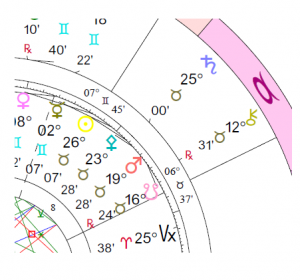 As time passes, and especially once a commitment is made between each other, the personal planet person will inevitably grow in that area of life or part of the personality represented by the personal planet. [Note that a commitment doesn’t necessarily literally mean marriage. It can be as simple as a commitment that the partnership is a one-to-one relationship, or that it is exclusive.]
What generally happens is that the security that bound the two together in the first place feels threatened on the part of the Saturn person as the personal planet person changes or grows. Saturn resists change, and feels threatened by it.
The Saturn person may exercise some kind of control over the personal planet person – some form of restriction. This can take the form of criticizing the energies expressed by the personal planet person.
Let’s take an example of Mercury conjunct Saturn in synastry. At the beginning, there can be a real feeling of mutual respect regarding how each person uses his or her brain, how they communicate, and how they think. The Mercury person may, in some ways, look up to the Saturn person, who tends to display a rather mature way of thinking that Mercury admires. Mercury may look to Saturn for advice, and Saturn responds with much enthusiasm, delighting in helping Mercury, and even teaching him or her.
As time goes on, inevitably Mercury will excitedly share an experience wherein he or she had an enlightening conversation with a friend – outside of their relationship. Saturn can feel mighty threatened by this simple experience. Saturn does not feel comfortable with that initial bond changing, or what he or she perceives as changing. Why isn’t Mercury turning to him or her? Saturn may deal with this fear by putting down the experience, punching holes in the theory that this threatening “other” has presented to Mercury.
It doesn’t even have to be about another person. Perhaps Mercury discovered on his or her own a new way of thinking that inspired him or her. This can be just as threatening to Saturn, who finds security in that initial bond that felt exclusive and special, whereby Mercury and Saturn came together with a mutual understanding that they turned to each other for advice and inspiring conversations.
In fact, anything that happens outside of the relationship in the area represented by the personal planet can be seen as a threat to the exclusive bond the couple had at the beginning of the relationship.
In truth, the bond is likely still there from the point of view of Mercury. But Saturn sees it differently. Saturn fears anything that threatens the initial bond they formed, and sees any signs of growth on Mercury’s part as a threat to that bond.
 We have all seen Saturn in synastry at work in some shape or form. An example involves a couple who initially bonded with each other on many levels, one of which was a shared sense of humor. In this case, the woman’s Mars formed a square to the man’s Saturn. In the early stages of their relationship, the woman found the man very funny. She broke into giggles at his jokes, and she expressed to him how she never laughed so much with a person in her life.
As time passed, she felt that whenever she found someone else funny or even something else funny, her partner came down on her in some way. He passed her a look of disapproval when she broke into giggles at something that wasn’t coming from him. His look would say, “What the heck is wrong with you?”
Sometimes, he wouldn’t just pass her a disapproving or superior look. He would say things like, “I really don’t know why you find that so funny.” As time passed, a dark cloud formed above the couple. She didn’t giggle as freely, as there is nothing more flattening as breaking into belly laughs only to be met with a look that says, “You’re so immature.” She began to feel that they didn’t share the same sense of humor, even though they most certainly did at the beginning of their relationship.
The man felt threatened by his partner finding humor in anything that did not originate between them. She began to feel unnatural around him, restricted, like he rained on her parade. She also began to view experiences when he was not around as a huge release. When they were apart, she felt freer to be herself. Thus, a distance was created between them.
Saturn in synastry is intriguing because what begins as a strong sense of security and comfort felt between a couple can eventually degenerate into feelings of pressure to stay the same, and an overall sense that one does not want the other to grow or develop.
Saturn generally is the one who wants the bond to be exclusive, and although the personal planet person generally wants the same thing, that personal planet person feels enormous pressure to be a certain way and feels like they are not free to express themselves in a natural and dynamic manner.
With repeated experiences in which the personal planet meets a critical or cold response from Saturn as a result of a spontaneous comment or action, the personal planet begins to censor himself or herself, and spontaneity is lost. Distance between the two is created, and a sense of being stifled, restricted, and censored slowly erodes the bond that felt so darn good at the beginning of their relationship. The personal planet person feels like they have to constantly monitor what they do or say in the presence of the Saturn person.
Let’s explore Moon-Saturn interchart aspects as another example. This cross-aspect is a powerful one. Either one (or both) people involved may have made it clear at some early point in the interaction that this relationship was to be a serious or committed one. Whether or not it was verbalized, the air of responsibility is explicit.
Although the relationship may begin with some element of enthusiasm, over time, Moon may feel the need to censor feelings of dependency on the relationship and on Saturn himself for some reason or another.
Moon may also feel the need to censor self-expression, feeling almost like a child facing a disapproving adult. Moon may sense a certain level of seriousness and even harshness or narrowness in Saturn that may not even exist in absolute terms. Saturn may not even be aware of this unconscious reaction to Moon.
Whatever it is, Moon can feel somewhat constrained by the relationship, and unable to express the “child” within, simply because of the expectation that Saturn may not approve, may not be capable of understanding, or may not be equipped to handle these expressions.
The sense that Moon gets is that Saturn’s needs for commitment are paramount, and that “frivolous” expressions of neediness or dependency wouldn’t be appropriate; or that expressions of dependency on anything or anyone else will be met with Saturn’s disapproval. It may also be that situational factors are such that true emotional intimacy is blocked, even though both parties want to get closer to each other.
The caution here is to avoid too much “censoring” to the point that Moon feels emotionally isolated, misunderstood, or blocked. Does Saturn truly benefit from this kind of “censoring”? Certainly not in the long run, because if it gets out of hand, Saturn will lose touch with Moon’s deepest needs, fears, and desires. Emotional distance doesn’t benefit either person. The chemistry in this relationship brings out the individual need for security and safety in both people, and each will certainly find a basic sense of safety with the other.
Although Moon in particular may feel emotionally frustrated at times, there is a feeling of constancy and dependability in Saturn that is very attractive. This relationship stands much chance of being a long-lasting one. However, it can have its fair share of ups and downs.
Periods of emotional distance and subsequent feelings that the relationship may be too “heavy” to maintain are often followed by tearful and emotional “reunions” when both parties feel that they need each other desperately, and that the attachment runs deeper than is always apparent. It is easy to see, with this kind of pattern, that either or both individuals could feel “trapped” together at times!
But the truth of the matter is, given the depth of the attachment to each other, there is much to gain from working on the intimacy issues described above. Saturn needs to face his or her fears and consciously work on not clamping down on Moon, and Moon, instead of reacting defensively to Saturn, must also look to see whether Saturn does have a point, so to speak, and Moon can actually benefit from some of the more reasonable boundaries that Saturn seems to draw.
Karma is associated with Saturn, where the personal planet person feels some sort of personal debt to the Saturn person. The Saturn person seems to have the upper hand in the relationship, at least for a while. Both parties must be more mindful of what exactly they are doing.
A balance is possible, as the personal planet person may benefit from Saturn’s impositions, at least ones that are not purely based on fear. Maybe the personal planet person does need to learn to be more responsible and could benefit from some maturation, and Saturn can learn to loosen up in certain ways. Reacting defensively to each other will only exacerbate the problem.
Saturn trines and sextiles are generally considered supportive. They do have some of the characteristics described above, but generally there is less defensiveness between the two, and criticism is constructive if it exists. This goes both ways – the Saturn person is less threatened, and the personal planet person less defensive when faced with Saturn’s restricting energy. It is certainly easier to learn from each other this way.
Nevertheless, even with flowing aspects involving Saturn, the chemistry is such that there is a characteristic reserve or self-consciousness present in the relationship with regards to the expression of feelings, romantic desires, will, intellect, or sexuality, depending on the personal planet involved.
Although parallels are likened to conjunctions, when Saturn is parallel a personal planet in synastry, the interplay is easier than the conjunction. The Saturn person is not as inclined to criticism or control. Rather, the stabilizing influence of Saturn is more prominent.
Important Note: Personal planets overlaying the tenth house of a partner’s chart can express similarly, where the tenth house person takes on a Saturnine role to the personal planet person.
Back to Synastry article.
Intermediate and advanced students of Astrology might enjoy our article, SoulMate Astrology.
Don’t know the positions of your planets? Be sure to find out your personal astrology data online, at no cost.

THE ASTROLOGY OF LOVE & ATTRACTION: ARTICLES & GUIDES
Recommended and related reading:

Synastry: Understanding Human Relationships (affiliate link)
CafeAstrology.com Notes: This classic by Ronald Davison presents the cross-aspects of each planet in synastry. The interpretations are insightful and warmly written.
Saturn: A New Look at an Old Devil (affiliate link)
Liz Greene’s book about Saturn includes Saturn in synastry.