Astrology Topics: Midpoints
Midpoints in Astrology
Midpoints are the halfway point between two points. When astrologers talk about the Sun/Moon midpoint, for example, they are referring to the point halfway between the Sun and the Moon.
To illustrate with a simple example, if the Sun is at 10 degrees Aries and the Moon is at 20 degrees Aries, the Sun/Moon midpoint is 15 degrees Aries. See our article, How to Calculate the Sun/Moon Midpoint, for the method to calculate any midpoint (not just Sun/Moon).
Midpoints can be calculated for any chart–whether it’s a natal chart, transit chart, progressed chart, composite chart, and so forth. They reveal further information about a chart.
Because there are many midpoints to calculate, and thus quite a bit of information to take in, it’s easiest when you have a computerized list of midpoints for a given chart, particularly if the list is sorted into zodiacal order.
Astrologers generally consider hard aspects to midpoints as relevant. The hard aspect set includes the conjunction, opposition, and square, as well as the semi-square (45 degrees) and sesquiquadrature (135 degrees). Calculation programs that offer midpoint “trees”, showing planets and points that form hard aspects to midpoints, are ideal. Here is an example midpoints list from my chart:
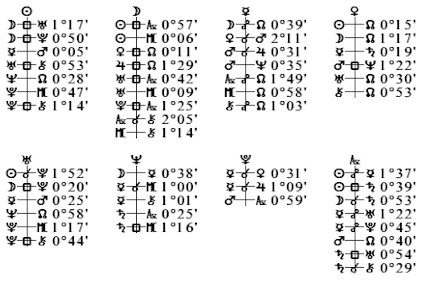
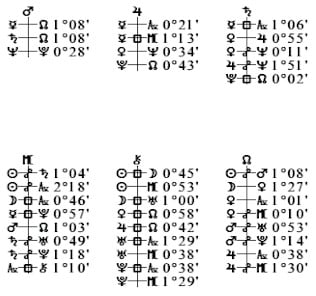
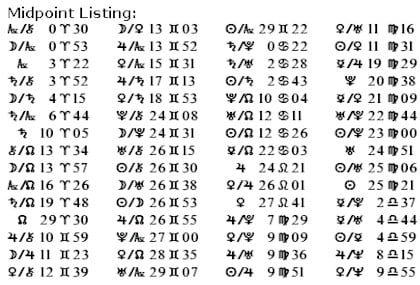
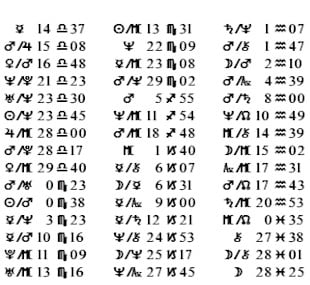
Midpoint notation involves inserting a slash between the two planets or points involved. Thus, a Sun ( ) Moon (
 ) midpoint would be:

The midpoint trees shown above reveal specific planets or points in aspect to midpoints. The following reveals that Mercury ( ) is in hard aspect to the midpoints listed.
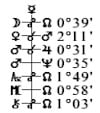
Because Mercury is conjunct the midpoint Venus/Mars ( /
/ ), we would note this configuration as follows:
 =/
=/
In fact, even if the aspect is an opposition, square, semi-square, or sesquiquadrature, we use the equal sign. The above example “equation” is officially called a “planetary picture“, and the diagram showing all of the midpoints in hard aspect to Mercury is a “midpoint tree“.
What is a Midpoint?
The use of midpoints historically goes back to 1200 AD when Guido Bonati, a famous Italian Astrologer, used half sums, otherwise known as midpoints, in his interpretation of a chart. More recently at the turn of the century, Alan Leo, a famous American Astrologer, used midpoints along with solar arc directions. I personally have no knowledge of the use of midpoints combined with the 90-degree dial prior to its use by Reinhold Ebertin and Alfred Witte at the beginning of the Nineteen Hundreds. The history of solar arcs on the other hand, goes back to Ptolemy who used primary directions in the second century.
A midpoint is the center between any two points, which in Astrology relates to the center between two planets and/or personal points, including the Midheaven, Ascendant, and the Nodes. This center point is the meeting of planetary energies that becomes active through the process of growth, relating to the passage of time. We relate to the aspects formed by the heavenly bodies through spatial relationship.
This system goes back to Reinhold Ebertin who, near the turn of the century, developed this system along with Alfred Witte by taking a 360-degree wheel and breaking it down into a 90-degree dial. Ebertin believed that hard aspects created events in one’s life; thus, the use of the 90-degree dial became a viable tool for forecasting future events.
Ebertin started by placing the planets into three sections — 30 degrees for Cardinal Positions which include: Aries, Cancer, Libra and Capricorn points; 30 degrees for Fixed Positions which include: Taurus, Leo, Scorpio and Aquarius points; and 30 degrees for Mutable Positions which include: Gemini, Virgo, Sagittarius and Pisces points.
This system can be seen on the 90 degree dial as 0 to 30 degrees as Cardinal, 30 to 60 degrees Fixed and 60 to 90 degrees as Mutable positions for the planetary points to be placed in accordance of their quality.
There are two midpoints that are exactly opposite one another for every pair combination of planets and points. The figure below gives you an idea of why this is the case:
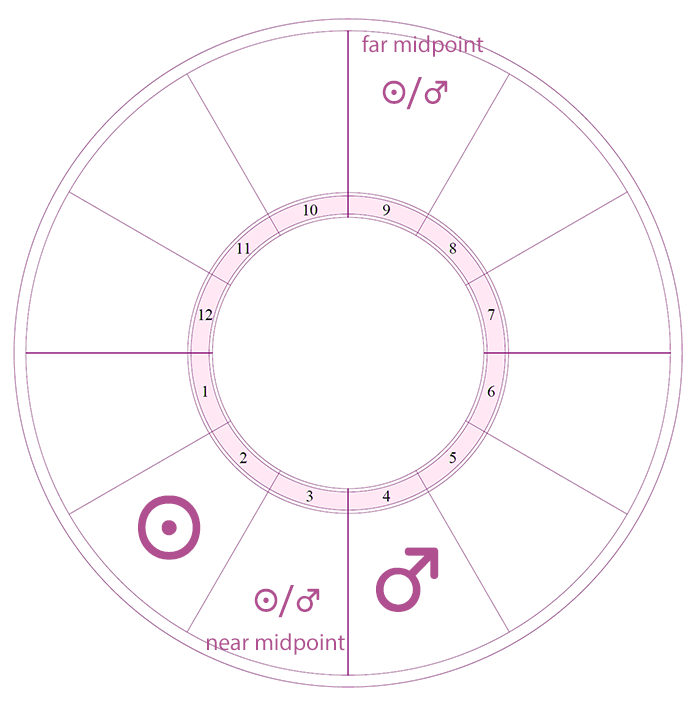
A near and far midpoint
The near midpoint is the closest middle point between the planets (above, the Sun/Mars). On the other hand, the far midpoint is found at the middle of the planetary pair in the furthest arc between them.
How do we go about interpreting the midpoints?
It is not a challenging task, by all means, if you are familiar with the symbolism of the planets and points involved. The Venus/Mars midpoint can represent many things. It can represent the coming together of male and female, and can literally symbolize sex in a romantic context, since the female and male sexual archetypes combine, or come together, at the midpoint of Venus and Mars.
Reinhold Ebertin in his most influential book, The Combination of Stellar Influences (affiliate link), referred to the Venus/Mars midpoint as “the impulse to love” and “passion”, amongst other things.
In Midpoints: Unleashing the Power of the Planets (affiliate link), Michael Munkasey offers many possible interpretations of the midpoint, as well as interpretations of planets and points at the midpoint. His interpretation of Mercury at the Venus/Mars midpoint is, “Discussions about your need for satisfaction from love and sex; communication about male and female roles in life; dialogues on the beauty of speed or acceleration; you find pleasure in observations”.
With Mercury = Venus/Mars in my chart, there is no doubt that I think about, and communicate about, relationships a great deal–the focus of this site is a testament to this fact!
On our Midpoint Pictures Interpretation page, planetary combinations of three planets are interpreted. There, Mercury-Venus-Mars means: “You have excellent aptitude for understanding the arts, and you are talented in artistic areas as well. You enjoy making things that are beautiful, and you succeed in areas that require an aesthetic sense as well as technical ability. You also have some talent for psychology, and you could be good as a marriage counselor, for example.”
Although it is not a challenging task to interpret specific midpoints if you are already familiar with planetary symbolism, it can be overwhelming if one were to attempt to interpret each and every midpoint in a chart. While I love the detail offered by midpoint interpretation, I use a scanning approach to midpoints in practice.
In other words, I look at the midpoint trees and scan them for midpoint pictures that stand out. In a natal chart analysis, I look for the Sun/Moon midpoint first and foremost. Any planet in hard aspect to the Sun/Moon midpoint will be a very important element in a person’s relationships.
We can approach midpoint analysis from a psychological or developmental viewpoint. In a natal chart, the energies at play with a midpoint that is in hard aspect to the Sun will be very much a part of the native’s ego. The native will take pride in, and identify with, this combination of energies.
An individual can be particularly sensitive to the combined energies of a midpoint in hard aspect to the Moon. The native will think about and communicate about the combined energies of a midpoint in hard aspect to Mercury. Each planet can be interpreted similarly.
We can also approach midpoint analysis from an event-oriented or practical viewpoint. This might be especially appropriate when we consider transits to midpoints and midpoint structures. When, for example, Pluto transits opposition Mercury, we can incorporate the midpoints affected by Pluto into our analysis of the transit. Of course, we can also interpret transits to individual midpoints.
Using keywords and general knowledge of planets and points, multiple “sentences” can be constructed to interpret planetary pictures. For the midpoints themselves, we can blend the energies of both planets and points together in a similar fashion as in our interpretations of aspects between two planets. The creative side of astrology truly comes into play here. For example, with Mercury/Pluto midpoint, words like “persuasion”, “research”, “investigation”, and “obsession”, and phrases like “intense discussions” and “suspicious thoughts”, come to mind.
When I “scan” midpoint trees in a natal chart analysis, I look for planetary pictures that jump out at me. If I see, for example, Sun=Venus/Mars, and if it “fits” with the rest of my impression of the chart, I might feel that the native’s sex and romantic life forms a large part of his identity. His ego rides on his relationships. If I see Moon=Sun/Saturn, I think in terms of emotional reserve, strength, perhaps some isolation or feelings of being left out, and the taking on of responsibilities, especially with regards to family, and possibly burdensome or excessive responsibilities.
Essentially, midpoints help me refine my interpretations of any given chart. There are astrologers who work extensively with cosmobiology, and who value planetary pictures over the sign and house positions of planets. However, I use midpoint analysis as a secondary consideration to help refine my interpretations.
As mentioned earlier, midpoints can be listed for any type of chart. If the same planetary picture Mercury=Venus/Mars as found in the natal chart in the example above is found in a composite chart, interpretation is similar, but instead we are interpreting a chart of a relationship, and this fact must be kept in mind.
Another issue with midpoint interpretation is that there are multiple interpretations for any given planetary picture. In this case, Mercury=Venus/Mars in the composite chart might suggest a couple who talks a lot about sex or their relationship, or it might mean that communication is a stimulant in their sexual relationship, or it could point to a rational or logical approach to romance/sex wherein the relationship is defined over and over again. Whether it points to steamy verbal exchanges or a cerebral quality to the romance we cannot say from the planetary picture alone.
The fact that there can be multiple manifestations for any given planetary picture is not limited to midpoints. In astrology, there are multiple levels, or layers, to the interpretation of any aspect, sign position, and house position. Above, I equated the Mercury=Venus/Mars midpoint in my own chart with my tendency to think about, analyze, and communicate about relationships. However, I also have Mercury=Mars/Jupiter in my chart. One might expect that I think and communicate about sports events, or religion, or that I do business in foreign trade, which I do not. Neither do I communicate in an aggressive, competitive, or especially energetic manner. Perhaps that can be explained by an opposition of Saturn to Mercury.
But what does it mean? How does it manifest? On a behavioral level, it might point to a tendency to gloss over details in order to arrive at a happy conclusion, and/or an overestimation of abilities, and/or a tendency to make decisions quickly and optimistically without considering all angles. On our Midpoint Pictures Interpretation page, Mercury-Mars-Jupiter means: “You have very good mental aptitude for many different subject areas. You are good at understanding both the general concepts and principles as well as specific details. You have a constructive mind that enables you to apply your understanding in practical ways. You can do well in an academic setting, as well as in the business and commercial world.”
In our Synastry/Relationship Astrology section of the site, we discuss the importance of the Sun/Moon midpoint in chart comparison. A personal planet in hard aspect to another person’s Sun/Moon midpoint is a rather binding contact. There is either a feeling of, or a promise of, a sense of completion from the planet person, and these contacts are very significant.
Read more about the Sun/Moon midpoint.
Many times, we can read other people through our own personal chart, since these people become the players in one’s personal “movie.” These “players” include midpoints with:
Moon = Mother
and the Feminine principle
Saturn = Father/Business Associates, masculine principle
Mercury/Mars = Brothers and Male Relatives
Mercury/Venus = Sisters and Female Relatives
Sun/Node = Children
Venus/Uranus = Female Friends
Mars/Uranus = Male Friends
Jupiter = Grandparents
Relationships include almost any midpoint involving the Sun, Moon, Venus and Mars, combined with the personal points, Asc, Mc, Moon, and Node. We should keep in mind the rulerships of these positions.
The natal midpoints represent our birth traits, our strengths, weaknesses and potential for personal growth. Each midpoint could involve others who are part of our life path.
Thus, a natal midpoint may apply to family and friends rather than the energy being directed to the self. The timing of the events indicated by natal midpoints are activated by progressions, directions, and finally transits as the final touch-off point sometime in the future.
Interpretations of Midpoints
See also: the meanings of midpoints, midpoint or planetary pictures interpretations, and alternate interpretations of midpoint pictures.
We offer a Midpoint Report – this computerized report lists and interprets all of the midpoint pictures in the natal chart, as well as midpoint pictures created over time: transits, progressions, and solar arc directions to midpoints in the natal chart, for 6 months.
References & suggested further reading:**
(1) The Combination of Stellar Influences (affiliate link) by Reinhold Ebertin offers interpretations of midpoints and planetary pictures. A classic.
(2) Midpoints: Unleashing the Power of the Planets (affiliate link) by Michael Munkasey offers interpretations and keyphrases for midpoints and planetary pictures. More modern definitions.
**Please note: Some of my recommended products contain affiliate links. If you purchase a product through my links, I may receive a small commission. I only include these because it comes at no cost to the buyer -- there are no additional charges and it does not cost a customer anything extra to buy through an affiliate link. I am a participant in the Amazon Services Associates Program–an affiliate advertising program designed to provide a means for sites to earn advertising fees by advertising and linking to amazon.com and products on that site. I only add links to products that I have personally used and recommended.
Sponsored Links:
Related Pages:
Determining a Date of Birth from Astrology Data
Relocation Charts: How to Calculate

Astrology Topics: The Meaning of Midpoints
Astrology Topics: The Astrology of Money & Wealth
Declinations in Synastry: The Astrology of Relationships
Full Moons and the Astrology of Relationships
When You Don’t Identify with Parts of Your Natal Chart

Astrology Topics: Midpoint Pictures

Saturn Transits and Humbling Experiences
- Cafe Astrology Home
- Articles: Learn Astrology
- The Astrology of Love & Intimacy
- Compatibility
- Recommended Astrology Books
- Best Times for Business Success, Good Luck, and Romance & Sexuality
- Site Index