Solar Returns 1
interpreting solar returns
Predictive Astrology – Techniques for Predicting the Future
On this Page:
- Overview of Solar Return Charts
- An Example Solar Return Chart Interpretation
- Personal Notes
Solar Returns Feature
On this first page of our Solar Returns Feature, you’ll find my preferred techniques and key points to consider when interpreting Solar Returns, as well as an example Solar Return interpretation. Note that I sometimes abbreviate “Solar Returns” as “SR”.
On page 2 of our Solar Returns Feature, a second example of a Solar Return at work.
On page 3 of our Solar Returns Feature, more techniques for fine-tuning a Solar Return analysis.
On page 4 of our Solar Returns Feature, interpretations of the Ascendant sign in the Solar Return chart, as well as the natal house brought to the Solar Ascendant.
On page 5 of our Solar Returns Feature, interpretations of the Solar Return Sun in aspect to other Solar Return planets and points.
On page 6 of our Solar Returns Feature, the importance of the Moon in the Solar Return chart, by sign, house, and aspect.
On page 7 of our Solar Returns Feature, comparison of books and suggestion of resources for interpreting Solar Returns.
General:
A Solar Return chart is a chart calculated for the exact moment when the Sun returns to its natal position (within 2 days of one’s birthday). This chart can be read much like a natal chart, except that it must be kept in mind that it is in effect only for the course of a year–approximately from birthday to birthday. [Some astrologers believe the Solar Return is in effect for a longer period of time.]
It is especially important to have an accurate birth time when working with Return charts.
Note that you can create your own Solar Return chart with some key interpretations with my Zodiacal Free Chart service.
Note that astrologers work with lunar returns and planetary returns as well. I interpret Venus Returns here.
Keys to Interpreting Solar Returns:
A Solar Return chart can be read in as much detail as desired. Some key points to consider are as follows:
1- The Ascendant of the Solar Return chart will color the individual’s approach to his or her environment for the year. For example, if Aries is on the Ascendant in the Solar Return chart, the individual may approach the year with increased energy and enterprise, and perhaps with some impatience. It describes the individual’s overall temperament and attitude during the period. Read more about the Solar Return Ascendant sign. The ruler of the Ascending sign, and its position by sign, house, and aspect, will hold more information as to the individual’s general temperament and focus for the year.
2- Note which planets and points in the natal chart, if any, are effectively brought to an angle of the Solar Return chart. Let’s say, for example, that the Solar Return Ascendant is 22 degrees Virgo, and the natal position of Venus is 24 degrees Virgo. The natal Venus is, therefore, conjunct the Solar Return Ascendant, and one can presume that the condition and issues surrounding the individual’s natal Venus will be highlighted (effectively coming to the fore) in the Solar Return year.
This consideration shows us what natal conditions, or inherent personality issues, are highlighted in the year of the Solar Return. If, for example, you have a natal Sun square Mars, and the Sun is on the Solar Return Ascendant, perhaps with Mars on the Midheaven as well, we can safely presume that the Sun-Mars struggle or challenge will be especially highlighted in both a personal (Ascendant) and public (Midheaven) manner.
3- Similarly, note which Solar Return planets are on or aspecting Solar Return angles. These are transits that are emphasized in the year of the Solar Return.
4- What is the condition of the Sun? Where is it located by house? (We know the sign, of course, because it will be at the exact natal position). This can show a strong area of focus for the upcoming year. The house position of the Sun in the SR chart shows where (which areas of life) the individual wants to shine. The individual will take pride in this part of his or her life, and a big ego investment lies in this area. He or she has the opportunity to rejuvenate this area. What kind of aspects does the Sun make? See interpretations of the Solar Return Sun in aspect.
5- Another area of focus this year can be found by determining which natal house is effectively brought to the Ascendant. For example, if the Solar Return Ascendant is 14 degrees Cancer, and this degree is found in the natal fifth house, the natal fifth house is effectively “brought” to the Ascendant, and will be another area of focus.
6- Where is the Moon? The position of the Moon by house and sign will show where your heart is, so to speak. If, for example, the Solar Return Moon is in Libra in the 5th house, you will likely to be emotionally tied up in, and concentrated on, love and relationship. A strong need for personal self-expression will be characteristic of the year, and emotional ups and downs are likely to occur in this area of life, simply because this is where your heart is–this is the area of life that you have the biggest emotional investment in–and you may not be completely rational and “in control” in this area.
More than simple fluctuations will be in store in this area of life if, for example, the Moon is also forming a square to Pluto in the Solar Return chart. Profound changes are likely to occur here. Thus, factoring in the Moon’s aspects will help refine the reading. Read more about the Solar Return Moon by sign, house, and aspect.
7- Note that a Solar Return chart can be read much like a natal chart, always keeping in mind that it is transient rather than permanent. If you are interested in looking at a specific area, such as finances, you can study the Return’s second house, eighth house, and the condition of Venus. For example, if Solar Return Venus is opposite Solar Return Neptune, especially if Venus also rules the second house in the Solar Return, you might presume that either this coming year there is less emphasis on materialism, or that your income might be fluctuating and somewhat unstable.
8- Get an overall feel for the Solar Return chart by examining hemispheric emphasis, whether or not it is scattered, and which houses (angular, succedent, and cadent) are emphasized. Also, note the qualities of the dominant signs of the year (cardinal, fixed, or mutable).
9- You know the upcoming year will be a “big” one (in a transitional sense) when the Solar Return Sun forms a hard angle with the Solar Return Moon. This is also true when the Sun is conjunct a Solar Return angle.
10- A consideration that I have found to be particularly significant is critical degrees. The most significant critical degrees in Solar Return interpretation are 29 degrees and 0 degrees of any sign. When found in the SR chart, there can be significant events surrounding the energy of the planet/point itself, and/or the house it rules in the chart. I do look at the classic critical degrees as well but as a secondary consideration.
For an insightful and rather thorough analysis of the Solar Return chart, look to Planets in Solar Returns: Yearly Cycles of Transformation & Growth [paid link] by Mary Fortier Shea.
Example #1:
Let’s look at an example. The following is the natal chart of Ann:
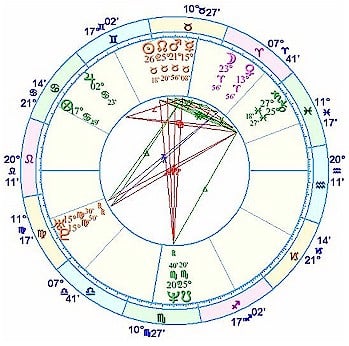
The Solar Return chart for the year we are studying is presented below, along with Ann’s natal chart in the outer wheel so that we can easily see which natal planets conjunct the Solar Return angles.
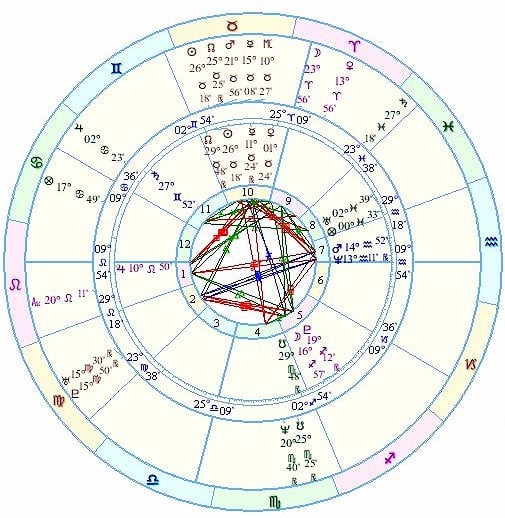
Immediately, I honed in on a few standout features involving the angles:
-
Solar Return Jupiter is conjunct the Ascendant (rising) in the Solar Return chart, and it opposes a conjunction of Mars and Neptune on the Descendant. Mercury squares this opposition, forming a T-square. All planets involved are in the foreground (angular), in prominent positions in the Return chart.
-
The natal Moon conjuncts the Solar Return Midheaven.
-
Solar Return Mercury is conjunct the natal Midheaven.
We also note that there is a conjunction of the Moon and Pluto in the Return chart, and that it trines SR Jupiter, and sextiles SR Mars and Pluto.
Many different issues came to the fore in the year in question. Most notably, her good friend with whom she maintained a friendship with for a few years, committed suicide and a murder on the same day. This, of course, came as a complete shock, and the violent act rocked Ann’s world. She had no clue that this man who seemed to be quite “together” could have committed such acts.
Ann, of course, struggled with this tragedy for some time after it happened. She struggled with guilt (did she ignore signs he may have been displaying?), loss (of a friendship), shock, and anger. If we had looked at the Solar Return chart before the events happened, we would not have been able to predict what actually happened.
However, we may have easily seen that Ann would confront some powerful emotional issues, perhaps in a public manner (natal Moon conjunct the SR Midheaven), and that she would struggle with illusion/guilt/anger/excess with regards to her personal relationships (Mars conjunct Neptune at the Descendant). Mercury rules her natal 11th house of friendships, and it also rules her Solar Return 11th house. Mercury (both natal and Solar Return) is found in the 10th house conjunct her natal Midheaven, effectively bringing 11th house issues into the fore in a public manner.
The SR Moon conjunction to Pluto suggests an emotional crisis of sorts. James A. Eshelman, in his book Interpreting Solar Returns, describes this aspect as “Sharp, intensive alterations in life situations; dramatic transformations…Experiences elicit a profound, climactic emotional response (crisis, shock)…Encountering the unlikely, improbable, unbelievable.” (1)
Of course, we cannot expect something as dramatic as what happened in Ann’s life to occur as a result of the individual factors found in the Solar Return chart and noted here. For example, Neptune conjunct the Descendant in a Solar Return chart, taken alone, can very certainly represent the encountering of disillusionments in close relationships. It can also suggest a year in which the native looks for new meanings in relationships, for example.
It is interesting to find Jupiter prominent in Solar Returns and transits when, for example, a person has had an accident, or goes through something like Ann did. At first, it seems counter-intuitive because we consider Jupiter the planet of luck. Indeed, it does have a protective influence. Perhaps prominent Jupiter suggests a level of protection in the sense that the person survived the incident or crisis.
Another way of looking at it is that Jupiter is the planet of expansion and excess. Effectively, it does represent some level of drama. Involved with Neptune and Mars, and we can easily see that it expanded or emphasized the Mars/Neptune issues of disillusionment. When in difficult aspect especially, Jupiter can suggest over-confidence and recklessness or misjudgment as a result.
See Example 2 
References & suggested further reading:
(1) Interpreting Solar Returns by James A. Eshelman. (affiliate link)
Planets in Solar Returns: Yearly Cycles of Transformation & Growth by Mary Fortier Shea. (affiliate link)
We have Solar Return computerized reports that examine any given Solar Return chart piece by piece. We have two different styles, and each report is $4.95.